Monday, June 29, 2009

The Early Years of the Hastings Literature Club

By Julia House

Editor’s Note: This year the Hastings Literature Club, the oldest cultural organization in Hastings, celebrates its 100th anniversary. Its first president was Julia House, author of last week’s reminiscence on the village in the first decade of the 20th century. Julia and John House lived in the Tower Ridge area from 1903 until 1909, when they built themselves a new house on Sheldon Place. Julia describes it as “up in the fields where we used to take the children to pick daisies and look at the cows.” Even before the move, Julia had become involved with a group that later became the Literature Club. What follows is an edited version of an informal history of that organization that Julia wrote in 1942.


I think I may claim for that early group that they did work their brains just a little harder than we do to-day. We made our programs with the idea of not merely reading a book and then sharing the best of it with the Club; we were supposed to take a literary subject, read as many books as we could get hold of and could find time to read on that subject – then boil down the knowledge thus gained, and to the best of our ability, in a strictly limited time, present it to the Club. In short, we wrote papers and we read our papers, and I really wish that some of the best of those papers could have been preserved along with the records, just to show what we could do in those days. …

The Club began as a very small group, probably in 1905 or ’06 – the exact date seems to have become lost in the mists of antiquity – when a few women in Yonkers began meeting to read and discuss books. Sarah Hine [wife of photographer Lewis W. Hine] and Josephine Murlin [wife of John R. Murlin] were the prime movers in this modest enterprise. There were others whose names I have forgotten as they dropped out when the group became centered in Hastings.

This came through the Murlins moving to Hastings. Soon after they came here, Mrs. Murlin invited some of her new friends, who were later to be her neighbors on Locust Hill, to join the group. That was when Mrs. Bennett, Mrs. [Ina] Griswold, Mrs. [Margaret] Sanger, Mrs. Matthew, and I came in, making it a considerably larger circle. Mrs. Hine and Mrs. Middleton still came up from Yonkers faithfully and the rest of us frequently jogged down there in the trolley for meetings with them.

Ina Griswold, one of the founding members of the Literature Club, on the far left, attends a meeting of the club around 1960 in the home of Phyllis Andrews. Her daughter Ruth sits with her back to the camera, and across from her are Harriet Haug (right), and possibly Miriam Pomeroy (next to Ina).

Naturally with so few members, each one entertained often, but the entertaining was very simple. Tea was the only beverage ever served, and with it we might have crackers or maybe some peppermints. So it wasn’t much of a burden on the hostess and left our minds pretty free for Literature. The custom of bringing our sewing or knitting to the meeting dates from those early days, when we were only too glad to sit quietly and darn the children’s socks or let down the hems of their dresses, away from the little dears for a time, and to the soothing accompaniment of good literature. I am glad that, as we have grown bigger, we have still kept to those informal ways and are still more like a gathering of real country neighbors than a proper women’s club. …

In 1909 we actually became a Club, for then we adopted a constitution and elected officers – a President, Secretary, and a Chairman of the Program Committee. … For the first few years, our programs were mostly based on syllabi of Literature courses given at Columbia, but after a while we got away from those, and our Program Committees depended on the preparatory reading they did themselves as a basis for the year’s work. …

The Literature Club's certificate from the New York State Education Department registering it as a "study club" in 1910.

After doing English literature with some degree of thoroughness, we turned to the literature of other lands – France, Germany, Russia, Ireland, the Scandinavian countries, getting a great deal of pleasure and at least some new knowledge. After we felt we had had enough of foreign culture for the time being, we turned to our American writers and found that a great deal was to be learned about them, more than we had studied in school. We found fresh viewpoints and new appreciation of familiar writers. …

I was under the impression that during the First World War we suspended our meetings for at least one winter for I seem to remember nothing of that year of 1917 but making surgical dressings in Mrs. Fink’s dining room. But it seems we did keep up our regular meetings listening to the programs while doing this work and always meeting at the same place where the materials were kept. That was a sober time, but I am sure we were drawn closer together, not only our group but the whole community, by the strains of the times. …

And it is good that we can still go on together for a while, old friends and newer ones. Our Club has enlarged our vision and brought us into contact with great minds, but most of all it has been a source of both inspiration and relaxation because of the friendly feeling, the almost family feeling of it, the welcome sympathy in times of trouble, the never failing interest of each one in all the rest. May there always be a Woman’s Literature Club of Hastings-on-Hudson.

A portrait of Mrs. Julia House in 1918.

The Historical Society has a large collection of material from the Literature Club, including an (almost) complete set of programs. The records have been organized for us by members Barbara Thompson and Helen Barolini, and Susan Korsten and Diana Jaeger have created the display on the club that is currently on view at the Historical Society. Christine Lehner, another member, is gathering material for an article about the club and its history. Watch the Hastings Literature Club blog for more information.
♦DiggIt! ♦Add to del.icio.us ♦Add to Technorati Faves

Thursday, June 25, 2009

Mystery Photo: Dedication of Hillside Park Swimming Pool

Here are three photographs of the dedication ceremony for the Hillside Park Swimming Pool. They were taken in 1965, though we don’t know the exact date. Perhaps it was late spring, at the beginning of the pool season. After the death of young Julius “Butch” Chemka in 1983, the swimming pool was renamed in his memory.

We have a few identifications for the photographs. In the top photograph, for example, the woman in the front row facing the camera is Janet Wagner, wife of Mayor R. Sheldon Wagner. And next to her is Rev. Edmund Fabisinski from St. Stanislaus Kostka. But we’d like to know more! Do you recognize anyone else? Do you happen to know the date of the dedication ceremony? Let us know!

If you don’t know, but are curious about the answers, come back to the blog and check this post. We’ll attach comments with any information we receive.

Mayor Sheldon R. Wagner addressing the crowd at the dedication.


Pool life guards, including Steve Zahurak standing at the far right, and Lane Pettibone kneeling on the left. Do you recognize any of the others?

♦DiggIt! ♦Add to del.icio.us ♦Add to Technorati Faves

Monday, June 22, 2009

Our Village in 1909

by Julia House

Editor’s Note: As much fun as it is to look at hundred-year-old photographs of Hastings, it’s even more exciting to have someone tell us what Hastings was really like in 1909. This reminiscence is an edited version of “A Long Look Backward,” an article written by Julia House around 1955, which we recently uncovered in a box of papers from the Literature Club. Julia moved to Hastings as a newlywed in 1903, and here’s what she has to say about her early years in Hastings.

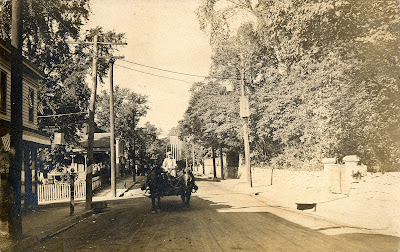
Warburton Avenue in 1909

Hastings was a sleepy village in those days. None of the streets were paved, and the occasional motor-car was something to stare at. In summer the watering-cart jogged up the main streets, wetting down the dust. The Brandt mansion, now occupied by the Veterans, was almost concealed by masses of shrubbery.…

I had never known a place like Hastings, and it took me some time to feel a part of it. It was so different from my New England, and so I called it very Dutch….

Mr. Joe Murphy, proprietor of the “Bridge Grocery” sent us a polite letter, asking us to deal with him. This was flattering, and we at once became customers. Each morning Mr. Murphy or his assistant would call at the back door to take orders, and deliver in the afternoon. It was not long, however, before we were notified that since so many people now had telephones, the orders would in future be given by that means. We had not contemplated anything so startling, but now it seemed we really needed a ‘phone, so it was duly installed in our little hall. It was not handsome, but it did look important, sitting up there on the wall, with its crank at the side which, briskly turned, would summon the operator.…

Fred Breyer in his market ca. 1909

My marketing, for meat, was mostly at Breyer’s, on Spring Street near Maple Avenue. In winter, the market was as cold inside as out-doors, and Mr. and Mrs. Breyer, both large, were swathed in so many garments they were positively gigantic. In summer, they must have had ice for the meat, and returned to normal size.…

There was little social life, as far as I could see. The men got to know each other, going to the city on the train, and sometimes would bring their wives together, but card-playing seemed to be the only amusement….


The Tower Ridge Yacht Club in 1905

Our great boon was the Yacht Club, so near us, and easily reached (I thought then) by a long flight of wooden steps going down into the ravine and a bridge over the railroad tracks. My husband enjoyed the sailing races on Saturday afternoons and could always have a job as able-bodied seaman on somebody’s boat, until he had one of his own, shared with a friend. But the sailing was not very good. Thunder-storms were always coming up, or else the boats would be becalmed, and sometimes they wouldn’t get in until midnight.

The Club was a paradise for the boys of the neighborhood, as it was later for our own sons. There they learned to swim – the river was cleaner then – and played among the boats under the watchful eye of wiry little Ed Cook, “Cap” to them, as to their fathers. Cap had strong language at his command, but usually the boys obeyed him without his resorting to it….

You would hardly believe what a nice little beach there was, down by the riverside, before the tracks were moved out to their present location. I used to take my young son down there to play contentedly with shovel and pail, and watch the boats on one side and the “choo-choos” on the other. We early acquired a small rowboat, and used to venture across the river on calm days, but it was a venture, since we never could be sure it would stay clam. It usually didn’t, and the return trip was sometimes too exciting to be pleasant. But we enjoyed exploring the other side, which seemed a different world, quaint and quiet, with its old stone cottages and winding, uphill roads. Hastings seemed almost urban when we got back to it.

Gus Wagner in his sleigh in 1905

Our first two winters were extremely cold, with snow on the ground all winter. People drove across the river in sleighs, and we used to drag our baby across, tucked up in a box on a sled. Those two winters were something to remember, with the wind roaring down from the North Pole, and blowing right into our defenseless little house. It was a wonder we and it were not blown away entirely. It was impossible to keep warm, with the old hot-air furnace, a fireplace in the dining-room, in which we burned cannel coal, and the kitchen stove, which perhaps did the best job. Our relatives in the city did have something on us, then. But in spite of the rough winter, we still loved our home by the river….

Julia House’ reminiscences continue next week with the early history of the Literature Club. Julia was the first president of this club, which was founded in 1909.
♦DiggIt! ♦Add to del.icio.us ♦Add to Technorati Faves

Thursday, June 18, 2009

Mystery Photo: High School Gym Class?

Here are four photographs showing girls in what seem to be school gym uniforms. We’re guessing that the photographs were taken some time in the early 1950s. In the top photograph, one of the girls is holding a baseball bat. In one of the others, the girls are holding batons and standing in front of what looks like the door to the Farragut Inn on the corner of Warburton Avenue and Spring Street. Maybe they have been in a parade?

Do you recognize any of the girls? Let us know!

If you don’t know, but are curious about the answers, come back to the blog and check this post. We’ll attach comments with any information we receive.


♦DiggIt! ♦Add to del.icio.us ♦Add to Technorati Faves