Showing posts with label Reminiscences. Show all posts

Thursday, July 8, 2010

A Fourth of July Parade – 1910s style


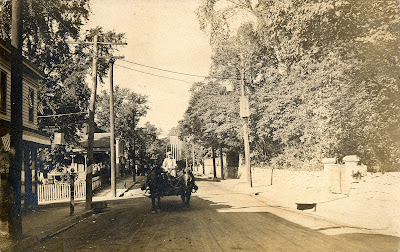
In 1941, long-time Hastings resident Stephen Zebrock wrote a column for the Hastings News called “Main Street Through the Years.” In this column, he set down everything he could remember about his childhood in Hastings in the late 1910s. This week, we thought you might like to read what Stephen wrote about Fourth of July parades. (The photographs that illustrate this post are from the 1914 parade. For more information, click on a specific photograph.)

“Parades were really an event in our lives. A Fourth of July parade would have every kid in the village agog for weeks in advance. Who would march in it? Which band would lead? Where would they start? Ann and I and Margaret and Emma Rimar would awake at six A.M. actually waiting! Finally at eight o’clock or so we’d rush downstairs, wash up, dress, and dash out into the front yard.

My father had built a large picket fence insuring privacy and also a box-seat view of any Main Street proceedings. A hundred precautions to keep our clothes clean, and we’d finally hear distant drums beating…. The parade was coming! Across Warburton Avenue Bridge, we could see the gaily-colored stream of people marching toward us. There they were—going up Main Street.

Look! There’s Louie [Zebrock, Stephen’s older brother], and Steve Snyder, Joe Meyer, and other members of Hastings Brass Band. There too was Mr. [John] Prince, Kitty’s father. Next came Capt. [William] Cronell, looking like a general out of a history book, at the head of our police force. Then came the school children (no one under the fifth grade was allowed to march) all decked out in their finest, all the girls showing their newly-made curls (after a night of torture). …


Next in line came some of the teachers. I recognized Miss [Kate] Crane, Miss [Agnes] McLave, Laura Caffyn, Mae Devery, Emma Van Nostrand, Grace Harlow, Margaret Waldbillig, Grace Sylvester, Mary Toole, Miss Senn (my teacher) and Mr. Peters, the Manual Training teacher. Our new principal, Mr. [H.H.] Murphy, lead this contingent. Following the teachers came some of our well-known and most popular citizens: A.W. Bevers, C.C. Delanoy, John Lawler, Jas. Magee, Dr. H.C. Sherman, Frederick Zinsser [owner of Zinsser Chemical Company on the waterfront], Dr. W.J. Doerfler, Louis Limekiller, and Nicholas Cook.

The Hastings Girl Scouts following the Boy Scouts took a round of applause. The Hungarian, Russian, Italian, Irish, and other local societies were well-represented, their native flags side by side with the American Flag.

About this time my mother would leave the kitchen to join Aunt Vera, Uncle John, my father, Mr. and Mrs. Szabo, and, generally, the proprietor of our home, Mr. Wagner, and his family. The parade stretched on, there were four or five different kinds of bands—from Uniontown, the Manor, from ‘the Juvenile Home’ up the Hill, and at least two or three brass bands. Finally, only a gang of kids trailed by…. The parade was over.

At the holiday spread, the one topic of conversation was the parade. “Didn’t Captain Cronell look dignified. Didn’t our Louis play better than all the rest? Wasn’t Mildred Young pretty in that girl scout uniform. Bill Hogan looked like a real captain. And the new dress on Kathlyne Collins! Mr. Zinsser looked like a Major in that uniform. And did you notice Dr. Doerfler marching?” This was a sample of the talk around the dinner table. We didn’t know whether to eat or talk. After all, didn’t everyone in the village turn out? And hadn’t people come for miles just to see our parade? Darn tootin! A parade in Hastings was an event in those days.”

DiggIt!Add to del.icio.usAdd to Technorati Faves

Thursday, May 6, 2010

House Tour Preview: Kenneth Clark – Neighbors and Guests


Our May 22 & 23 house tour will include the home of African-American psychologists Kenneth and Mamie Clark. In 1950, the Clarks moved to Hastings’ Pinecrest neighborhood, the area west of the Andrus Memorial Home. They raised their children here and remained here until their deaths, Mamie in 1983 and Kenneth in 2005. In 1990, Historical Society Trustee Coleman Barkin interviewed Clark for the Society’s oral history collection. The following is an edited version of that interview, in which Clark talks about his house, his neighbors, his friendship with the Lithuanian-born sculptor Jacques Lipchitz, and some of his more famous house guests.

(In the interview, Clark refers to “The Chances” who sold them their house. These were African-American lawyer Lucille Chance and her sister Sarah Grey. Their maiden name was Edwards, and under that name they ran a Harlem-based real estate business called Edwards Sisters Realty. Lucille was instrumental in bringing African-American families to Hastings. Her house will also be on our house tour.)

The view: the Hudson River seen from the Pinecrest neighborhood in 1929.

INT: Where did you first live?

KC: In New York City, in Washington Heights. As I said, [Mamie was] from Arkansas, and a home—she didn’t particularly like living in an apartment. So she said we ought to look to find a home, and this was the first place we looked -- Hastings. Our neighbors, the Chances, who have a home up here, were in real estate and they showed us this home. … She liked it, I liked it. I liked the view, and that oak tree in the back is really magnificent, and the fireplace. We decided to buy it. We didn’t look any further. …

INT: Was Hastings an integrated community at that time?

KC: As far as we knew. There were about three or four black families in this area. It seemed like a pretty integrated area. I had a very good friend, Robert Merton, who lived up the drive. … He’s a professor of Sociology at Columbia. … I’ll never forget the first Christmas we were here. We hadn’t yet fixed up the house. The bell rang, we went to the front door and there was Bob Merton and a group of neighbors who came to sing Christmas carols and whatnot. That was really a very impressive event for us. It told us, really, that it was a decent community … . One of the things that fascinated me was that in the Pinecrest area whites and blacks interchanged in selling. A white family would sell to a negro family, a negro family could sell to a white family. …

INT: What kind of reputation did Hastings have?

KC: A pleasant place, a pleasant suburb. … It seemed the type of place that one would like other places to be like. …

INT: Did you use the parks around here, or the aqueduct?

KC: Yes, sometimes. In fact, I used to walk down the aqueduct to [sculptor Jacques] Lipchitz’s studio on Sundays. We would sit and talk. We were quite friendly. … I walked down and I saw his studio, and, of course, I’ve always been impressed with Lipchitz. In fact, I have one of his pieces upstairs that I’ll show you. We’d sit and we’d talk. We’d talk about Picasso. He was quite a person, a very gentle man. …

INT: Was he working continuously? Was he sculpting all the time?

KC: He did quite a bit of sculpting, yeah. And he didn’t seem to mind taking time out for us to sit and talk. And I visited his home there … . He has a lot of African art.

The Old Croton Aqueduct running alongside Pinecrest Drive in 1931.

INT: What did you talk about besides Picasso?

KC: Events – what was happening in the world. We had similar ideology. …

INT: You had mentioned to me, when we last spoke, that you had different friends come up and spend some time here. [Singer] Paul Robeson, you said he’d been here, and [writer] Jim Baldwin.

KC: Paul Robeson had been up with the Chances. Martin Luther King had spent some time here with us as a guest. …

INT: Were they here just socially, or did you have meetings?

KC: Socially and meetings. Meetings with Roy Wilkins, Whitney [Young] [both prominent civil-rights activists], and others. …

INT: Why did you meet here, rather than in somebody’s office?

KC: That’s a very interesting question. It was a… I guess it was a secret. I think Martin was staying with us. As I told you it was fascinating, we had lunch upstairs and discussions down here [in the library]. …

INT: What was [Jim Baldwin] like?

KC: He was like Jim Baldwin. We had long discussions. We’d have more discussions with Jim than we would with Martin. Martin was easy going. I only saw him angry once. Jim was sort of voracious. I liked him. Mamie liked him. In fact, we would not have guests here, particularly those that were staying for a while, who we didn’t like … .

INT: You said you saw Martin Luther King angry once?

KC: Once he was angry with [civil-rights activist] Roy [Wilkins], who was opposed to his anti-Vietnam position. I must say Whitney was quite the negotiator. I admired Whitney’s ability to reconcile. … [But] I certainly was very much on [Martin’s] side in the anti-Vietnam. I guess I was a part of history – here in the Pinecrest area – although by no means publicized.

Sculptor Jacques Lipchitz at work in his studio ca. 1965.

DiggIt!Add to del.icio.usAdd to Technorati Faves

Thursday, February 11, 2010

Happy Birthday Hastings Theater

The Hastings Theater in 1929

Today is the 90th birthday of the Hastings Theater, which opened amid great fanfare on February 11th, 1920. We are lucky enough to have an eye-witness account of this event written in 1967 by Steve Zebrock (also known by his stage name of Alan Brock). In 1920, Steve was eleven years old and living with his family on lower Warburton. To earn enough cash to get to the Yonkers movie house on the weekend, Steve and his friends delivered newspapers for the Hastings News. But they kept a keen eye on the site next to the Hastings News office where architect Foster L. Hastings of Ridgedell Avenue was superintending the construction of Hastings’ very own movie theater.

“… in December, 1919, the Hastings theater building stood before us in all its magnificent glory, and Mr. Hastings decided to let us in on the opening night attraction: Douglas Fairbanks in “The Mark of Zorro”! We cheered the posters out front – Doug was then America’s favorite movie star. …

A few days before the opening of the “Mark of Zorro” a heavy snowstorm blanketed Westchester – actually more of a blizzard. The kids were scared – maybe the movie wouldn’t open? Fortunately Mr. Hastings stuck to his word. … Despite the snow, the weather was not too cold, and parents, with offspring holding on, were spread all around the theater.

This was a real “dolled up” night, the likes of which most of us village kids had not seen before: Members of the first families were arriving in their motors, with some of the men in Tuxedos and the ladies in evening gowns and fur capes. Among the first of the leading citizens was the Walker Whiteside family. Mr. Whiteside was a famous Broadway stage star who lived in Tower Ridge. His young and lovely daughter Rosamond was also a well-known actress. Next came the Wuppermans, Ralf and Frank, known to Broadway as the Morgan brothers [Frank Morgan would later play the Wizard of Oz in the 1939 movie]. Claudia Morgan, who later became famous on Broadway, radio, and TV, was the daughter of Ralf. There was a loud cheer as the shining Rolls Royce belonging to Billie Burke and Florenz Ziegfeld pulled up. The Zinsser family soon drove up, Mr. and Mrs. Frederick Zinsser with their beautiful daughters Ellen and Peggy, and handsome son Jack. …

Within a few seconds the cashier’s window was raised and the head of Anna O’Hara welcomed us from behind it. The first honorary tickets went to Village President Thomas Goodwin and his family. After that came the Thomas Reynolds family, and Mr. and Mrs. Egbert Handy and their pretty daughter Edna, and gradually the crowd moved comfortably indoors.

The young Steve Zebrock

Once inside the theater itself, we were awe-struck. This was not a narrow tunnel-like movie such as the ones we had been accustomed to. The auditorium was brilliantly lighted and wonderfully warm. Brand new carpets stretched down the entire length of the aisle to the stage, and the wall lights looked like real candles burning. We were proud of our Hastings Theater.

The excitement of this special night was quickly reaching its climax. We grabbed seats down front right behind the orchestra put and reveled in all the splendor surrounding us. … At last the lights began to dim and Foster L. Hastings walked down the aisle with a few of the village dignitaries. A sudden hush fell over the entire audience as Mr. Hastings began a speech of welcome. He then brought on the Village President, Mr. Goodwin, to a round of applause, and a few more familiar faces. More applause and whistling, then – the stage was empty.

The piano quietly went into music from the opera “Carmen,” in keeping with the Spanish mood of “The Mark of Zorro.” The lady at the piano was Gordon Smith’s mother. We all knew her. Mrs. Smith was the most popular pianist in Hastings. [Gordon Smith says that his mother was invited to play for the opening and stayed for the next three years.] At the end of the mood music, everyone in the auditorium broke into applause. The next minute the screen flashed Douglas Fairbanks in “The Mark of Zorro.”

When the last close-up of Douglas kissing beautiful Marguerite de la Motte faded from the screen there was a sudden let-down. Back to earth. The lights were on again and the miracle was over. But we knew that ahead of us were more miracles. Now we had our own movie theater. And Hastings, for us, was on the map at last.”

Hastings Theater right after it closed its doors in 1977. In the years that followed, it was under consideration for several businesses – an antique shop, a movie house for films in Spanish, housing for senior citizens, a theater for training young Broadway hopefuls. In 1986 it was remodeled into the Moviehouse Mews.

DiggIt!Add to del.icio.usAdd to Technorati Faves

Thursday, January 21, 2010

A Moment of Glory for 25 Main Street

By Judy (Wemer) Chamberlain

Movie crew in front of 25 Main Street, transformed with temporary tiling and potted plants into a Santa Barbara restaurant. (photo copyright Anne Marie Leone)

Hastings was all a buzz this past summer with the news that a movie was being filmed on Main Street. It is exciting when something out of the ordinary happens in a small town. It gives everyone something to talk about, and it makes for good “people watching.” The featured actors included Meryl Streep, Steve Martin, and Alec Baldwin, though only Meryl was in the scene shot this June in the village.

It’s Complicated, the new romantic comedy written and directed by Nancy Meyers, chose to feature one of my favorite buildings in town. The First National Bank building, on the corner of Main and Whitman, was built in 1907, and through its long history the building has housed an assortment of businesses.

Postcard from about 1912 showing the bank building

My connection to 25 Main Street was through a dentist. Dr. Stewart had his office on the second floor. Mounting the steps was like marching to the gallows. I would walk down from school with dread for my afternoon appointments. I remember that the waiting room was austere, the magazines of little interest to me, and time waiting for my turn in the chair, unbearable.

There was one bright spot though. The receptionist was a lovely lady with silver gray hair, who always had a large colorful handkerchief attached to her stiff white nurse’s uniform. Her name was Mrs. Feury. I think her first name may have been Beth, but since I never called her anything but Mrs. Feury, I’m not certain. She was efficient and tried her best to put patients, especially nervous children, at ease -- no small feat given the antiquated drills that awaited you beyond the closed door.


Photograph from 1929 by A.C. Langmuir. The slogan on the window reads: "Love and Thrift Make Happy Homes."

Today the office of dentist Dr. Harvey Kutz is located at 25 Main. However, now for at least the run of this newly released film, the sturdy brick building with its pleasant arches, will be famous in Hastings for its transformation into a restaurant.

Unfortunately, only those who stopped by in person to watch will know this, because the scene shot here ended up on the cutting room floor. For the rest of us who intently watched the film to spot our landmark, well, we’ll have to be content to know that this fine building brought a film crew, Oscar-winning actress Meryl Streep, and some excitement to Hastings.

Editor’s Note: We have lots of photographs of 25 Main, but not when it was Dr. Stewart’s office. Does anyone have such a photograph that they could lend us?

The lost scene: Meryl in the rain. (photo copyright Anne Marie Leone)


DiggIt!Add to del.icio.usAdd to Technorati Faves

Thursday, January 14, 2010

Mystery Photograph: Ferrera’s Meat Market


Back in 2008 when Carol Venuto Davis wrote her wonderful article for the Hastings Historian on her house at 4 Spring Street, she included this photograph of herself (right) and her sister Priscilla (peeking over her shoulder) in Fererra’s meat market, taken around 1953. We recently asked her to tell me more about the photograph, and here is her answer.

“That's the owner Mr. Ferrera in the long white apron cutting a piece of meat. The two men behind the counter were working for him, but I can't recall their names. The men standing behind my sister are customers. Don't know them either.

The photo was taken for advertising—they had just installed some new meat counters, and I think the local paper was doing a story about that. It was nice of Mr. Ferrera to give me a photo, but then, we were regular customers. Mom sent us there a couple of times a week because she felt they had good quality meat.

I remember the shop always smelled of fresh sawdust and the meat was placed in white cardboard containers then wrapped in brown paper and tied with a string. You don't get that kind of service any more.

One of our chores was to go to Ferrera’s for meat, and buy groceries including fruits and vegetables at the A & P supermarket across the street—you can't really see it in the photo but my sister is holding Mom's shopping list and I'm clutching the money. The butcher or grocer would tally the amount on the wrapping paper or bag, and we were supposed to wait there and make sure the addition was correct before paying. It was good training in budgeting at an early age since I was 11 and my sister 8 years old at the time the photo was taken.”

Please let us know if you can identify the men in the picture. And if you have any memories of the meat market to share, send them along!

Ferrera Brothers market at 546 Warburton Avenue in 1935. The photograph show, left to right: Alfred Ferrera, Jack Cattell, Lillian Cattell, Frank Ferrera, and Albert Ferrera.

Carol is also looking for information about people who might have lived in her family home, 4 Spring Street, before her grandparents bought it in 1926. Some of the names listed on old deeds to the house include: Michael Kablack, Louis & Lizi Babulicz, Abraham & Carrie Oppenheimer, Fannie Leitner, Michael & Agnes Masterson, Jane Scriven, William Kinder, Frederick Kinder, Garret A. Veeder, George W. Bippell and Sidney S. Blackwell.

Let us know if you can help her!
DiggIt!Add to del.icio.usAdd to Technorati Faves

Monday, August 24, 2009

Ice Cream Memories

By Judy Chamberlain

The soda fountain at Todd's Drugstore ca. 1910 (for more information on any image, click on the photograph)

Now that summer days are finally warming up, ice cream has become the snack of choice for children of all ages. Though many consider it an all-year-round treat, I enjoy ice cream, sorbets, and popsicles most in the summer. Really, who can ignore the bells of an ice cream truck as it swings into a neighborhood? As a child, I know that I couldn’t.

Ice cream was always deliciously special when I was growing up. Today we can readily buy pints of Ben and Jerry’s, Edy’s fruit bars, and Carvel flying saucers, but back in the 1950’s, most home refrigerators had small, inefficient freezer compartments with little extra space for frozen treats. If my parents brought home a quart of ice cream or some ice pops, we were forced to consume them immediately.

The solution to this dilemma was the Good Humor truck that seemed to come by at just the right time each day. Decked out in a white uniform with a silver coin holder on his belt, the Good Humor man was a kid’s summer hero. Gathering a crowd around him, he’d open the magic door that offered cool relief for all those who came running. He’d take an order, pluck out the frozen bar or cup, and deliver heaven to the waiting hand. Ah, the simple pleasures of childhood.

August J. Bruning behind the counter of his ice cream parlor ca. 1925

Because our apartment was on the fourth floor, as soon as I’d hear those bells enter the neighborhood, I’d quickly run to my building and start calling up to my mother to ask if I could get something. She too heard the bells, but didn’t want to walk down those four flights. So she would open a window and toss some money down. Though she usually wrapped the coins in a napkin or a hanky, they often scattered on impact and left me hunting in the grass for a glistening nickel or dime. And the next year, when I’d moved to Clunie Avenue, I was delighted to hear the bells of summer and discover that the Good Humor truck came to this street too, arriving just after dinner, the perfect time for dessert.

If you were in the village and wanted ice cream, nothing was better than August J. Bruning’s homemade. It was here that I ordered my first banana split and discovered that it was way too much of an ice cream treat for one little girl. Future visits brought me back to my favorite -- strawberry ice cream. Bruning’s eventually turned into the Cup and Saucer and remained a town favorite for years.

Jacobson's Pharmacy in 1929. The white signs in the windows read ‘Good Chocolate Soda’ and ‘Chocolate Malted Milks’. The sides of the main sign above the shop carry the Hydrox Ice Cream logo.

Ice cream parlors and soda fountains have always been popular in Hastings. If you found yourself at Doc Todd’s in 1910, you might have had a sarsaparilla or a dish of peach ice cream. From the late 1930s into the 1960s it was known as Joe Algeo’s Pharmacy. My Dad spent a summer working behind the counter as a “soda jerk,” whipping up cherry cokes and chocolate sodas with vanilla ice cream. Or maybe you went into Jacobson’s Drug Store in the 1940s and were tempted to sample the pineapple sundae or have a coffee ice cream cone while spinning on a fountain stool.

In 1924, Charles Liede operated an ice cream parlor at 2 Main Street. I think that had turned into The Sugar Bowl by the time I was growing up. This location may have also been the site of Adam’s Ice Cream Parlor. During the 1920s Billie Burke would often treat the local children to ice cream there, and not just to a one-cent size cone. The Historical Society records indicate that she would spring for the larger, five-cent serving. And the favorite new flavor back then was tutti-frutti. Now how special was that!

Of course, there were the neighborhood spots to stop in for something cool and creamy. Pantelemon’s, south of the Warburton Avenue Bridge, had a nice soda fountain, and so did Lambert’s on Farragut Parkway. Or you might go into Whitey’s market, near the bridge, and find the most flavorful ice pops around. There were many choices, many flavors, and many memories made each summer day in Hastings.

Sam Caruso mans the soda fountain in Jacobson's Pharmacy in 1946

DiggIt!Add to del.icio.usAdd to Technorati Faves

Monday, August 10, 2009

Admiral Farragut: Legends of a Hastings Hero

Part II: I Sailed With Farragut

Admiral David Glasgow Farragut (for more information about any photograph, click the image)

Last week’s post included several stories about David Glasgow Farragut’s early days in Hastings in 1861. But the reminiscences of Civil War times that were printed in the local papers in the 1920s and ‘30s also contained more personal memories of Farragut. William McConnell must have been a great storyteller in those days, because many of his childhood memories found their way into print -- memories of swimming in the Saw Mill River and of being chastised by the master of the local “little red schoolhouse”. In the 1930s, the Hastings News carried a story of his acquaintance with Admiral Farragut’s family.

“For a year or more the lad had been carrying two pails of drinking water a day to the cottage on Washington Avenue. The spring at the northwest corner of Washington and Broadway provided drinking water for the neighborhood. Young Willie McConnell received a quarter a week pocket money for the carrying of a heavy pail each morning and each evening to the Farragut door. He still remembers the southern mammy who presided in the kitchen and who took the pail from the boy’s hands.”

But of all the stories told in Hastings about Farragut, the most exciting must be the one about James Hitchcock. In 1933, a Hastings News reporter got the story from James’s younger brother William, who was seventy-seven at the time.

“Young Jim Hitchcock, reckoned the village’s boldest blood, who was reputed to be able to spit tobacco farther than anyone in Hastings, was a close neighbor of the Farraguts. Perhaps it was during the inactive summer of 1861 that the Captain first took an interest in the boy. Probably the lad worshipped the old Captain and listened by the hour to tales of the sea. At any rate, when Captain Farragut was sent to the Gulf Squadron, Jim Hitchcock went with him. The captain had promised the sexton [Jim’s father] and his wife to find a berth for the lad that would not take him into direct action.

Hastings' Admiral Farragut Post of the American Legion posing with a model of the "Hartford" presented to President Roosevelt ca. 1938.

‘Jim was many years older than me. …I wasn’t born when Jim went off to the Spanish waters with the Captain,’ Mr. William Hitchcock told the representative of the Hastings News who called upon him the other day. ‘Yes, that’s what we called those parts at the time – the Spanish waters. I’ve heard my father and mother tell about it often, how Jim went with the captain, and how the captain made him a sailor...’

‘Yes,’ Mr. Hitchcock went on, ‘Jim was on the Hartford with the Admiral, and Jim fought at Mobile Bay. I’ve heard him tell the tale many a time of how three men at the wheel were killed by a shot that went clean over his head because he happened to be stooping down at the moment. The Admiral’s promise to my father and mother? It wasn’t his fault he didn’t keep it! It was Jim’s. The Admiral told my father when he came back that he had tried to put Jim on another ship, but Jim had coaxed for the Hartford. ‘You’ll get your damned head shot off you then, Hitchcock,’ said the Admiral to Jim, ‘and it won’t be my fault either.’ ‘Yes, sir,’ said Jim and he stayed with the Admiral. I’ve heard him tell that story many times.’ ”

And where was Jim Hitchcock in 1933? Nobody knew. “He came back to see us every few years,” William told the Hastings News. “Every few years until thirty-five years ago, and then Jim never came again. I went down to Snug Harbor a few years ago looking for him, but his name wasn’t on their lists of old sailors. Jim must be dead by now.” The Sailors’ Snug Harbor on Staten Island was the first home for retired sailors in the United States. It opened in 1833 and lasted into the 1960s. That property is now the Snug Harbor Cultural Center and Botanical Garden.

The USS Hartford, on which Jim sailed, was one of the last wooden warships and had been commissioned in 1858. She was set on fire during a battle in 1862, but was saved by Farragut and his crew and continued to be Farragut’s flagship for all his major naval victories. The news of their neighbor’s exploits no doubt thrilled the villagers of Hastings. But they had no opportunity to show their tremendous pride and admiration for their local hero until the Admiral’s return to Hastings in the winter of 1865. That spectacular homecoming is the subject of next week’s post.

Decorative stamp showing the "Hartford" organized by local residents for Hastings' 1936 Farragut Day, celebrating the 135th anniversary of Farragut's birth

DiggIt!Add to del.icio.usAdd to Technorati Faves

Monday, June 29, 2009

The Early Years of the Hastings Literature Club

By Julia House

Editor’s Note: This year the Hastings Literature Club, the oldest cultural organization in Hastings, celebrates its 100th anniversary. Its first president was Julia House, author of last week’s reminiscence on the village in the first decade of the 20th century. Julia and John House lived in the Tower Ridge area from 1903 until 1909, when they built themselves a new house on Sheldon Place. Julia describes it as “up in the fields where we used to take the children to pick daisies and look at the cows.” Even before the move, Julia had become involved with a group that later became the Literature Club. What follows is an edited version of an informal history of that organization that Julia wrote in 1942.


I think I may claim for that early group that they did work their brains just a little harder than we do to-day. We made our programs with the idea of not merely reading a book and then sharing the best of it with the Club; we were supposed to take a literary subject, read as many books as we could get hold of and could find time to read on that subject – then boil down the knowledge thus gained, and to the best of our ability, in a strictly limited time, present it to the Club. In short, we wrote papers and we read our papers, and I really wish that some of the best of those papers could have been preserved along with the records, just to show what we could do in those days. …

The Club began as a very small group, probably in 1905 or ’06 – the exact date seems to have become lost in the mists of antiquity – when a few women in Yonkers began meeting to read and discuss books. Sarah Hine [wife of photographer Lewis W. Hine] and Josephine Murlin [wife of John R. Murlin] were the prime movers in this modest enterprise. There were others whose names I have forgotten as they dropped out when the group became centered in Hastings.

This came through the Murlins moving to Hastings. Soon after they came here, Mrs. Murlin invited some of her new friends, who were later to be her neighbors on Locust Hill, to join the group. That was when Mrs. Bennett, Mrs. [Ina] Griswold, Mrs. [Margaret] Sanger, Mrs. Matthew, and I came in, making it a considerably larger circle. Mrs. Hine and Mrs. Middleton still came up from Yonkers faithfully and the rest of us frequently jogged down there in the trolley for meetings with them.

Ina Griswold, one of the founding members of the Literature Club, on the far left, attends a meeting of the club around 1960 in the home of Phyllis Andrews. Her daughter Ruth sits with her back to the camera, and across from her are Harriet Haug (right), and possibly Miriam Pomeroy (next to Ina).

Naturally with so few members, each one entertained often, but the entertaining was very simple. Tea was the only beverage ever served, and with it we might have crackers or maybe some peppermints. So it wasn’t much of a burden on the hostess and left our minds pretty free for Literature. The custom of bringing our sewing or knitting to the meeting dates from those early days, when we were only too glad to sit quietly and darn the children’s socks or let down the hems of their dresses, away from the little dears for a time, and to the soothing accompaniment of good literature. I am glad that, as we have grown bigger, we have still kept to those informal ways and are still more like a gathering of real country neighbors than a proper women’s club. …

In 1909 we actually became a Club, for then we adopted a constitution and elected officers – a President, Secretary, and a Chairman of the Program Committee. … For the first few years, our programs were mostly based on syllabi of Literature courses given at Columbia, but after a while we got away from those, and our Program Committees depended on the preparatory reading they did themselves as a basis for the year’s work. …

The Literature Club's certificate from the New York State Education Department registering it as a "study club" in 1910.

After doing English literature with some degree of thoroughness, we turned to the literature of other lands – France, Germany, Russia, Ireland, the Scandinavian countries, getting a great deal of pleasure and at least some new knowledge. After we felt we had had enough of foreign culture for the time being, we turned to our American writers and found that a great deal was to be learned about them, more than we had studied in school. We found fresh viewpoints and new appreciation of familiar writers. …

I was under the impression that during the First World War we suspended our meetings for at least one winter for I seem to remember nothing of that year of 1917 but making surgical dressings in Mrs. Fink’s dining room. But it seems we did keep up our regular meetings listening to the programs while doing this work and always meeting at the same place where the materials were kept. That was a sober time, but I am sure we were drawn closer together, not only our group but the whole community, by the strains of the times. …

And it is good that we can still go on together for a while, old friends and newer ones. Our Club has enlarged our vision and brought us into contact with great minds, but most of all it has been a source of both inspiration and relaxation because of the friendly feeling, the almost family feeling of it, the welcome sympathy in times of trouble, the never failing interest of each one in all the rest. May there always be a Woman’s Literature Club of Hastings-on-Hudson.

A portrait of Mrs. Julia House in 1918.

The Historical Society has a large collection of material from the Literature Club, including an (almost) complete set of programs. The records have been organized for us by members Barbara Thompson and Helen Barolini, and Susan Korsten and Diana Jaeger have created the display on the club that is currently on view at the Historical Society. Christine Lehner, another member, is gathering material for an article about the club and its history. Watch the Hastings Literature Club blog for more information.
DiggIt!Add to del.icio.usAdd to Technorati Faves

Monday, June 22, 2009

Our Village in 1909

by Julia House

Editor’s Note: As much fun as it is to look at hundred-year-old photographs of Hastings, it’s even more exciting to have someone tell us what Hastings was really like in 1909. This reminiscence is an edited version of “A Long Look Backward,” an article written by Julia House around 1955, which we recently uncovered in a box of papers from the Literature Club. Julia moved to Hastings as a newlywed in 1903, and here’s what she has to say about her early years in Hastings.

Warburton Avenue in 1909

Hastings was a sleepy village in those days. None of the streets were paved, and the occasional motor-car was something to stare at. In summer the watering-cart jogged up the main streets, wetting down the dust. The Brandt mansion, now occupied by the Veterans, was almost concealed by masses of shrubbery.…

I had never known a place like Hastings, and it took me some time to feel a part of it. It was so different from my New England, and so I called it very Dutch….

Mr. Joe Murphy, proprietor of the “Bridge Grocery” sent us a polite letter, asking us to deal with him. This was flattering, and we at once became customers. Each morning Mr. Murphy or his assistant would call at the back door to take orders, and deliver in the afternoon. It was not long, however, before we were notified that since so many people now had telephones, the orders would in future be given by that means. We had not contemplated anything so startling, but now it seemed we really needed a ‘phone, so it was duly installed in our little hall. It was not handsome, but it did look important, sitting up there on the wall, with its crank at the side which, briskly turned, would summon the operator.…

Fred Breyer in his market ca. 1909

My marketing, for meat, was mostly at Breyer’s, on Spring Street near Maple Avenue. In winter, the market was as cold inside as out-doors, and Mr. and Mrs. Breyer, both large, were swathed in so many garments they were positively gigantic. In summer, they must have had ice for the meat, and returned to normal size.…

There was little social life, as far as I could see. The men got to know each other, going to the city on the train, and sometimes would bring their wives together, but card-playing seemed to be the only amusement….


The Tower Ridge Yacht Club in 1905

Our great boon was the Yacht Club, so near us, and easily reached (I thought then) by a long flight of wooden steps going down into the ravine and a bridge over the railroad tracks. My husband enjoyed the sailing races on Saturday afternoons and could always have a job as able-bodied seaman on somebody’s boat, until he had one of his own, shared with a friend. But the sailing was not very good. Thunder-storms were always coming up, or else the boats would be becalmed, and sometimes they wouldn’t get in until midnight.

The Club was a paradise for the boys of the neighborhood, as it was later for our own sons. There they learned to swim – the river was cleaner then – and played among the boats under the watchful eye of wiry little Ed Cook, “Cap” to them, as to their fathers. Cap had strong language at his command, but usually the boys obeyed him without his resorting to it….

You would hardly believe what a nice little beach there was, down by the riverside, before the tracks were moved out to their present location. I used to take my young son down there to play contentedly with shovel and pail, and watch the boats on one side and the “choo-choos” on the other. We early acquired a small rowboat, and used to venture across the river on calm days, but it was a venture, since we never could be sure it would stay clam. It usually didn’t, and the return trip was sometimes too exciting to be pleasant. But we enjoyed exploring the other side, which seemed a different world, quaint and quiet, with its old stone cottages and winding, uphill roads. Hastings seemed almost urban when we got back to it.

Gus Wagner in his sleigh in 1905

Our first two winters were extremely cold, with snow on the ground all winter. People drove across the river in sleighs, and we used to drag our baby across, tucked up in a box on a sled. Those two winters were something to remember, with the wind roaring down from the North Pole, and blowing right into our defenseless little house. It was a wonder we and it were not blown away entirely. It was impossible to keep warm, with the old hot-air furnace, a fireplace in the dining-room, in which we burned cannel coal, and the kitchen stove, which perhaps did the best job. Our relatives in the city did have something on us, then. But in spite of the rough winter, we still loved our home by the river….

Julia House’ reminiscences continue next week with the early history of the Literature Club. Julia was the first president of this club, which was founded in 1909.
DiggIt!Add to del.icio.usAdd to Technorati Faves

Monday, June 8, 2009

The Sidewalks of Hastings

by Judy Chamberlain

When I was almost seven, my parents trusted me to walk to and from church each Sunday with my cousin David. He was a year and a half older than I was, so I guess they figured he was responsible enough to see that I got to St. Matthew’s safely and delivered to the nuns in time for 9AM Mass. Actually, we very rarely walked together. I usually trailed behind him, surveying the sidewalks along Warburton Avenue and trying not to step on any cracks.

I always found sidewalks very interesting and measured my walks accordingly; they were my distance guideposts. Close to my home on Nodine Street, the sidewalks were large rectangular pieces of smooth stone in pale shades of grey, blue, or rose that lay side by side by side. Next came the wide cement sidewalk, perfect for roller-skating, with patterns made by masons rather than by nature. This cement section lasted past the little grocery store and Mrs. Gondek’s office near the corner of Division Street. When you crossed Division, you walked on a tamped-down dirt path with wildflowers and weeds hugging the rock on your right, almost all the way to Williams Street. Nearing that corner, it was flat slate again. Then, after you crossed at the light at Washington, you stepped onto six-sided, black and white asphalt blocks. Here you practically had to walk on your toes if you wanted to stay within the lines.

Crossing the bridge was a breeze because the wide sidewalk was cement with pencil-thin horizontal lines every two feet or so, easy to hop over. On the other side of the bridge, and up to the corner near the Sugar Bowl, those hexagon tiles reappeared and carried you to the Main Street light. From Ben-Sun’s corner on down -- past the Center Restaurant, Kalender’s, the VFW wall, Manor Market, and Nana’s lunch -- I think it was just cement, but I’m not sure because I usually picked up my pace and ran the rest of the way so I wouldn’t be late for Mass.

This was the route we were instructed to take so that we didn’t have to cross Warburton, which most parents considered a major thoroughfare that required an adult to “cross” you. We were supposed to return home the same way, on the east side of the avenue, but many times we didn’t. Instead, we’d blend into the crowd sprinting from church to get to the Village Bakery before all the jelly doughnuts and crumb buns were gone. Once on the west side of Warburton, we might get to see the fire truck, if Protection Engine’s door were open, or browse the window displays of the shops and Whelan’s Drug.

We always moved faster once we crossed the bridge. Since we had to arrive together, there wasn’t time to avoid the cracks and there were few shop windows to attract our attention. It was just one apartment house after another, until we came to Pantalemon’s ice cream shop. It drew us in like a magnet. Bundles of newspapers with the funny paper sections on top lined the tables in front of the soda fountain on the left. On the right side of the shop was the glass case that displayed the penny candy. That’s what we called it, but some cost a nickel and others were two for a penny. Bubble gum, tootsie roll pops, papers covered with colored dots, Mary Janes and jawbreakers in box after box, and all at eye level. Such decisions! Neither of us ever had much money, but between the two of us, we could always get something to make the last steps of our trip the most enjoyable. Besides not telling we’d stopped in, our only other rule was that we had to eat everything we bought before we got home.

With our little brown bag of goodies, we dawdled from flat stone to flat stone until we reached the next set of apartments. There we would wait for some kind adult to cross us back over the big street so we could make our way up the hill to our apartments.

Editor's Note: The photographs in this post were taken by A.C. Langmuir in the 1930s, but they still make great illustrations for Judy's memories of Hastings sidewalks in the 1950s.
DiggIt!Add to del.icio.usAdd to Technorati Faves

Monday, May 18, 2009

Remembering the Hastings Record Shop

By Bob Russell

17 to 19 Main Street ca. 1960 (Hastings Record Shop on far right)

In the Fall 2008 issue of the Historian there is a wonderful story written by Carol Marie (Venuto) Davis regarding her family life and the eventual creation of the Steinschneider parking lot, which required demolition of her home. On page two of this issue, there is a photo of an old dual-use building on Spring Street that was removed in order to provide an entrance for this new public area. This old house had living space above and had the numerical destinations of #10 and #12. I have recently heard that The Hastings Record Shop had its first location in this building, and although I don't recall the shop when it was there I do remember very well how it was when it moved to 19 Main Street at the corner of Whitman (Lafayette Place).

This brick building also housed Ernie's Delicatessen, and the Hastings Five and Ten, a double store closest to the Boulanger Plaza, which was completed ca. 1957. For the record, the 5&10 was run by a Mr. and Mrs. Bromberger. Ernie's Delicatessen was (to my recollection) the first market-type store to use the designation "Delicatessen" until Marchioni's was opened two stores south of Nana's Lunch, across from the Hastings Trans Lux Theatre.

As for Hastings Record Shop, this is how I remember the store and its owners. Margaret and Will Hesketh were husband and wife. Will repaired radios in the back room, replacing tubes mostly. My older brother Bill was into radios and worked for Will for a while. Will had a small panel truck, and would pick up and deliver the repaired radios and TV's with a quiet and friendly smile. He would bring them in a rear door and would take them out to his truck while he was repairing them. Margaret ran the front of the store in a businesslike but friendly way.

As you walked in the front door, the counter was straight ahead, at the back of the store but in front of a partition wall that had a doorway to the repair area in back. There was a register to the left on top of the glass counter, and inside the glass case were various articles for sale such as record cleaning brushes, needles for 78's and later sapphire and diamond needles, plastic inserts for 45rpm records, etc.


Along the left (west) wall was a moveable rack containing slip cases of clear plastic which contained various record albums, both 78 and 33 rpm. You could move them individually from side to side, view and select a particular album which Margaret would remove for you to purchase. To the right of the albums were shelves for older stock 78's and many smaller cubbies containing the latest 45's.

These were the days of monophonic, as stereo was in its early stages and had only begun to appear toward the end of the Fifties. Only a couple of stereo records were available at the beginning, and mostly experimental, containing a variety of works, usually classical in content, such as the "Living Presence" album, ca. 1959.

If you were a regular customer of the HRS and wanted a particular record, Margaret would order it for you and call you when it came in. If a really popular album was about to arrive (Hastings Record Shop only stocked a couple of copies at a time to keep inventory down), Margaret would secretly hold a copy behind the counter for you on request.

I remember buying 78's for our Victrola there, and later The Everly Brothers, Elvis in 1956, Jimmy Rodgers singles in ‘57, etc. It was a treat to go there. Singles were .98 cents each and LP's were as high as $2.95. The store was spotless.


West side of Warburton Avenue with the corner of Spring Street on the far right. The photograph was taken by Steven Kormes during "Spring Thing" in May of 1980. The photograph shows the Hastings Record Shop, The Cheese Genie, The Sunshine Gallery, and King Pizza on the corner.


When E.J. Korvette and S. Klein On The Square opened their stores on Central Avenue, the Hastings record shop felt some loss of business, but continued to sell records, then eight track tapes and cassettes, throughout the Sixties and on into the Seventies, when I lost track of them. I recall hearing about Will’s death, and that the repair business was ended. Margaret continued on into the Eighties at a new location, 545 Warburton Avenue. For all of us who knew Margaret and Will, they were our friends, and will always be remembered as good people.
DiggIt!Add to del.icio.usAdd to Technorati Faves

Monday, April 27, 2009

The Barbers of Hastings

by Judy (Wemer) Chamberlain

Joe Manzi and a customer in Krueger's barber shop on Main Street

You never know what you are going to find when you visit the Hastings Historical Society. The cottage is a treasure trove of photos and maps, documents and books, and objects from another time. I often go to research one topic and get distracted by another that is equally fascinating. And you never know, you may bump into an old friend or neighbor while you’re there.

On two recent visits, I caught up with some former classmates who were making use of this wonderful resource. One day Liz Kapuster Douglas came down from Danbury to take a look at the wonderful postcard collection HHS has. It seems she collects postcards of Hastings. Who knew that there were so many postcards of Hastings? And a couple of weeks ago, I met Peter Seixas who was in from Vancouver to do a little personal research. Peter and I began to discuss events that occurred in Hastings when we were back in the 7th grade. It was certainly a ‘dust off your memory’ kind of encounter. We covered a range of subjects that included bomb shelters, barbers, mysterious happenings, and mutual acquaintances.

Our conversation about barbers jarred my memory to recall my visits to Jake with my brother Ray. Jake Hoffman’s little one-man shop was on Warburton Avenue. My mother would drop us off in front, and Ray and I would go in to sit quietly on the window seat and wait our turn. I say, “our turn,” because even though Ray was there for a haircut, Jake would also trim my bangs. I was never pleased with this idea because girls were supposed to go to a beauty parlor, not have a barber cut their hair. My mother tried to persuade me that Jake wasn’t just any barber; he was once the barber for Billie Burke and Flo Ziegfeld. I wasn’t impressed. Can’t say I recall when we stopped frequenting Jake’s, stopped staring at the small white hexagon tiles that dotted the floor, stopped watching customers ease themselves into that old barber chair with the wide leather strap dangling down. Eventually, I would have my hair cut in a few doors down at Dore and then at Dee’s by Dolores Radomski, but I fondly remember Jake the barber.

There I go, rambling off again. Almost every visit I make to the cottage triggers a memory or sparks an interest. It might be an old journal or map, a newspaper clipping, sepia print, or a happenstance conversation. Why not visit the cottage and see what you discover?


Editor’s Note: We’re always glad to hear that people think we have a great collection! But we don’t have everything we would like to have. Take, for example, pictures of Jake Hoffman. The best we could do to illustrate Judy’s post this week was the photograph of Joe Manzi at the top. The photograph directly above, taken in 1958, shows the building that Jake Hoffman had been in as it was being remodeled for Astoria Federal. Jake occupied the corner space on the far right, 558 Warburton Avenue, and shared it with Larry’s Beauty Salon. If you look closely, you can see part of the lettering for Larry’s sign. If you have any pictures of Jake or his shop, we’d love to have copies! And by the way, does anyone recognize the child in the photograph with Joe Manzi?

DiggIt!Add to del.icio.usAdd to Technorati Faves

Monday, March 30, 2009

Hunting for Easter Eggs

Back in the mid-50s, when I was in elementary school, the annual Easter Egg Hunt in town was a very big deal. This was the time when TV shows were in shades of black and white, and the Saturday morning line-up was the Modern Farmer followed by an endless stream of old-time cartoons. So a Saturday morning event for all the children of Hastings to enjoy was a welcome treat.

As I remember it, everyone would meet in the village, either at the VFW or old Youth Center and parade up Main Street toward five corners. When we arrived at that junction, we either headed straight toward Reynolds Field or took the right toward Draper Park. Each year the location was a closely guarded secret so that nobody could get an advance look at where the eggs were hidden.

Because we were part of the baby boom generation, we were a sizeable group moving towards our destination; no doubt we halted all traffic. Having felt the crush of the crowd, I think some years our numbers might have reached 60 - 70. Just prior to starting, all the children were categorized by age or grade. This gave everyone an equal chance at discovering an egg. And each age group had a different hunting area, with the more challenging areas and well-hidden eggs reserved for the older children. Parents weren’t allowed to participate, other than to watch the mayhem unfold as excited kids darted here and there looking for the eggs.

The eggs we hunted were made of wood and were painted various colors. I remember a silver egg and a golden egg, but I don’t recall if these had any more importance than the others did. The one and only year that I scooped up my egg, it was painted silver. When I turned it in, I was given a fabulous, cellophane wrapped, wicker basket full of sweets. Every Easter basket had one large chocolate bunny inside plus little chocolate eggs and bunnies, marshmallow chicks, and jellybeans of assorted color. Even if you didn’t find a wooden egg, no child left empty handed. Everyone was given a generous, half-pound size tub of jellybeans. It was great event. I think the South Side Club sponsored it, but I’m not certain.

Oh, I forgot the bunny. Every year the Easter bunny would appear at this event. I remember Margie McCarthy being the bunny when I was little. But since I’m the oldest of five children, I often went to the parade as the babysitter for my brothers and sisters. By the time I stopped parading some time in the 60s, the bunny was Cathy Zahurak.

Judy (Wemer) Chamberlain

From the editor: Here is the Hastings Social Club, one of the organizations that ran the Easter Egg hunts back in 1950. We know some of their names: left to right, front row: Bill McCauley, M. Gleeson [or Gleason?], Pete Carrie Sr., unidentified, Rudy Morrison and unidentified; second row: Jim Grady and unidentified; third row: Howard Pike, Abe Callahan, unidentified, Jack Duddy, and Martin "Brud" Feury; back row: Gerald Maher, Martin "Happy" Holloran, and Edward Maher. But we don't have any other information about them in the files! Can you help?
DiggIt!Add to del.icio.usAdd to Technorati Faves