Showing posts with label 1930s. Show all posts

Thursday, July 29, 2010

Bringing History to Life in the 1920s

Pocahontas and John Rolfe, after their wedding in the Jamestown church, from Jamestown, one of the Chronicles of America Photoplays.

If you had been sitting in the Hastings school auditorium on Friday, September 16th, 1932, you might well have seen the wedding of Pocahontas and John Rolfe. It would have been in black and white, and without any sound – but at least there would have been movement, history brought to life on the silver screen.

How do we know what a high schooler would have been doing on that particular day? Well, we were recently looking through the public school handbook for 1932-33, which is in our pamphlet file, and we became curious about several entries in the school calendar. Sandwiched between the G.O. elections and the Aloha Club dance are three days where the scheduled activity is “Chronicles of America”. A quick google supplied the information that the Chronicles of America Photoplays were films on American history. This series of fifteen silent movies, with titles like The Pilgrims, Peter Stuyvesant, The Declaration of Independence, Dixie, and The Frontier Woman, was one of the earliest educational film series. It was produced between 1923 and 1924 by Vitagraph Studios in Flatbush, Brooklyn, a studio established in 1906 that has been called the “first modern motion picture plant in the country.”

The real Hastings connection here is a person – Arthur E. Krows, who was scenario editor at the Vitagraph company. Krows wrote the scripts for the first two films in the series, Columbus and Jamestown. Krows lived on Farragut Avenue, directly across from the school, with his wife, known to the entire town as an animal lover and host to all the stray dogs and cats in the neighborhood. Krows’ brother was “Doc” Earl Krows, a local dentist, who lived on Euclid Avenue. It seems likely that Arthur Krows was the man responsible for obtaining, or encouraging the school to obtain, copies of the film reels to show to students.

The Chronicles of America Photoplays were based on a set of books called Chronicles of America published by Yale University Press between 1918 and 1922. “This series of fifty volumes,” declared the publishers, “is designed to tell the story of the United States, as it has never before been told… to present the entire history of our country in living form, so related that the reader will be given a real vision of his country from the beginning to the present day." And almost as soon as the first volumes went to press, the publishers had the idea of developing accompanying films that would further the goal of bringing history to life.

Director-General Peter Stuyvesant gives way to fury as the Councilors urge him to accept the English terms for surrendering the Colony of New Amsterdam, from the film Peter Stuyvesant.

The publishers contacted Krows at Vitagraph, who was enthusiastic about the project and agreed to become secretary of the Chronicles of America Picture Corporation, a joint venture between Yale University and Vitagraph. He set to work on the first two scripts and made arrangements for filming to begin. Richard Koszarski in his 2008 book Hollywood on the Hudson: Film and Television in New York from Griffith to Sarnoff describes the process. “Production soon began on Columbus, and the company was lucky enough to locate a full-scale reconstruction of the Santa Maria that had been floating in Chicago’s Jackson Park Lagoon since the Columbian Exposition of 1893. Although the Nina and the Pinta were by now considerably beyond repair, the Santa Maria was towed out into Lake Michigan for a few impressive establishing shots. Back in New York, an estate at Mount Kisco doubled for the palace of King John of Portugal, the La Rabida monastery was shot in Huntington, and beach scenes showing Queen Isabella’s messenger overtaking Columbus were filmed along the shores of Montauk. Interiors were built at the Vitagraph studio in Flatbush.”

The book series took history from the Indians to the presidency of Woodrow Wilson. Vitagraph was able to produce only fifteen films out of the proposed forty, and only got as far as the Revolutionary War before the combination of incredibly high production costs, conflict between the historian/editors and the filmmakers, and the collapse of the Vitagraph studio brought an end to the photoplays. (Arthur Krows himself resigned as secretary of the Chronicles of America Picture Corporation after an argument over changes that the Yale historians wanted to make in his scripts.)

But though the films may not have recouped their costs, they were popular enough with museums, schools, and local clubs that they helped establish a real market for educational film. As late as the 1950s, prints were still being circulated by various institutions, including the Metropolitan Museum of Art, the American Museum of Natural History, and the Pathe company, and in 1941 the Chronicles of America Photoplays became the first documentary film series to be shown on American television.

Congress assembled in Independence Hall on June 7, 1776 to vote on a resolution for independence, from the film The Declaration of Independence.

DiggIt!Add to del.icio.usAdd to Technorati Faves

Thursday, July 1, 2010

Heads Up – It’s the Hindenburg!


On the 9th of October 1936, retired chemist and camera buff A.C. Langmuir of 383 Broadway set up his camera to take a photograph of the zeppelin Hindenburg hovering above the Anaconda Wire & Cable Company on the waterfront. The same day, the following article appeared in the Yonkers Statesman under the title “Thousands Here View Hindenburg.”

“Thousands of Yonkers residents, craning their necks skyward and shading their eyes against a blazing sun, got their first view of the giant dirigible Hindenburg today.

The glistening German trans-Atlantic air liner was clearly visible in detail, from beaming nose to the colorful Nazi swastika on its tail. Its motors humming, the Zeppelin dipped low over the city, after making a graceful crossing from New Jersey and entering over South Yonkers. The flying level was estimated at 700 feet.

The passage over this city began at 8:50 A.M., about half an hour past schedule. Aboard were a party of commercial men, making an observation tour of Westchester County’s western sector, and prepared to cruise over New England, returning down the Long Island Sound and eastern Westchester this afternoon.

The dirigible glided north, over Hastings, Dobbs Ferry, Ardsley, Irvington, the Tarrytowns, Ossining, and Peekskill. Then it turned east toward Danbury, Conn. It was then to continue on a roughly elliptical course to Boston, and then return via Brockton, Providence, New Haven and Bridgeport, passing then over Port Chester and Mount Vernon.”

Map from the New York Times showing the route of the Hindenburg's 10-hour cruise.


The residents of Yonkers were not the only enthusiastic spectators – every inhabitant of every city that the zeppelin passed over was amazed at the vision of the Hindenburg hovering above them. Factory whistles blew to alert the residents to its arrival in a new town. Planes circled around the liner and dipped in salute. Schools recessed, and the children ran about in the streets shouting so loudly that they could be heard on the zeppelin itself. The New York Times reported that a Newark man had actually died after falling through a skylight while stepping back to get a better view!

And this was no surprise, for the Hindenburg was, and still is, the largest airship ever built. The Camden, NJ paper called her the “Queen of the Skies.” She was built for commercial passenger and mail service, and boasted a dining room, lounge, and writing room designed by the same artist who designed the interiors of ocean liners and luxury trains. The ship could carry up to 72 passengers, and for the trans-Atlantic service from Germany to the U.S. the tickets were $400 each (about $6,300 in 2010 dollars). As you might imagine, the passengers were mostly the very wealthy – politicians, athletes, entertainers, and industrialists.

The “Nazi swastika” on the tail end of the zeppelin may seem a little surprising for a commercial passenger carrier. It probably wouldn’t have been there if Dr. Hugo Eckener, chairman of the company that built the zeppelin, had had anything to say about it. It was Eckener who had insisted on naming his zeppelin after the former president of Germany, and not, as the Nazi propaganda office had instructed him, after Adolf Hitler. For this error, the German newspapers were not permitted to use Eckener’s name in any article they wrote about the airship. In Hitler’s Germany, the state ran the airships in partnership with Dr. Eckener’s company. Both the Hindenburg and the Graf Zeppelin were used for propaganda purposes in Germany, flying around the country dropping leaflets and broadcasting political speeches.

In 1936, the first year of its operation, the Hindenburg made 10 trips across the Atlantic. In October of that year it had reached the end of its official season. The flight over Hastings was part of a special 10-hour cruise before the ship returned to Germany for the winter. Its purpose was two-fold: to inspect sites for future airship air fields and to get the heads of America’s biggest corporations interested in the commercial possibilities of airship travel. Among the 84 passengers invited on the trip were Nelson Rockefeller, the presidents of Chrysler, Packard, and De Soto, and the president of the Goodyear Tire and Rubber Company. (Could this ride have inspired Goodyear’s future affection for blimps?) Every guest was enthusiastic over the smooth and comfortable trip. When the ship returned to its birth at Lakehurst Naval Air Station in New Jersey, Dr. Eckener was able to tell the press that “progress had been made toward the financing of two big rigid airships in this country.”

But almost exactly seven months later, for reasons still not fully explained, the Hindenburg crashed at Lakehurst airfield, killing 35 of the 97 people onboard. This disaster was so horrific that it brought the age of commercial airship travel to an abrupt end. Two days later, the Graf Zeppelin was grounded, and in 1940 the brand new Graf Zeppelin II was dismantled.

But on that clear day in October when A.C. Langmuir set up his camera to snap the photograph at the top of this article, the future of the zeppelin looked bright. Langmuir and the thousands of other people who saw the Hindenburg must have thought they were looking at the dawn of a new age – the glorious hydrogen-filled future of air travel.

Photograph from the October 9, 1936 article in the Yonkers Statesman.

DiggIt!Add to del.icio.usAdd to Technorati Faves

Thursday, April 29, 2010

Mystery Photo: 1938 High School Fire Squad


"FIRE SQUAD: The fire bell rings and students are efficiently rushed out of the building by the Fire Chief Albro Rile assisted by those ten strong men on the fire squad: Eben Chabot, John Moser, Walter Bennett, Jack Galvin, Frank Wills, Bill Burckhalter, Bill Kaufman, Joe Janik, and Chris Rohrbach."

So says the 1938 yearbook. And, as for a mystery, this should be an easy one! All you have to do for us is match up the names with the faces. Albro Rile is the boy holding the white helmet. Joe Janik might be the one to the right of Rile. Chris Rohrbach might be to the right of Janik, and behind him holding the hose might be John Moser. What do you think? Click the photograph to look at it more closely in Flickr. Choose the "All Sizes" link above the photograph, and then select "Original Size" so you can see the faces. If you can help with the identifications or know anything more about the activities of the fire squad, let us know!

The photograph below appears in the "snapshot" section of the yearbook, along with images of football games and the marching band. Is the quality good enough to recognize anyone?

DiggIt!Add to del.icio.usAdd to Technorati Faves

Thursday, October 29, 2009

Happy Anniversary A&P!

By Judy Chamberlain


During a recent trip to the A & P, I purchased some house blend coffee that came in a commemorative tin. The can’s copy heralds the dates 1859-2009 because the self-service chain is celebrating 150 years of service. The photo imprinted on the can reminded me of the small and simple A & P we once frequented, and the date triggered my memory back to 1960, when the new A & P supermarket finally opened its doors.

According to its website, nearly 150 years ago The Great American Tea Company opened a store on Vesey Street in New York City and began selling tea, coffee and spices at value prices. Soon stores sprang up all around the metropolitan area and salesmen took their wares on the road in horse-drawn carriages bound for New England, the mid-west and the south. In 1869 the Company was renamed The Great Atlantic & Pacific Tea Company, in honor of the first transcontinental railroad and hopes of expanding across the continent.

The original Great Atlantic & Pacific Tea Company in Hastings began selling groceries in the 1920s, and it was located on the west side of Warburton Avenue. Although I don’t remember much about the interior at this location, I do remember the strong aroma of coffee that wafted from a large coffee grinder that was located near the cash register. And I also remember the pincers, a long handled device that the clerks used to manipulate and grab items off the top shelves, Although the A & P was generally self-service, both the grinder and the pincers required an assistant’s help; watching these tools in operation made going to the grocery store a more interesting experience.

Two photographs of Warburton Avenue from 1936 spliced together show the Great Atlantic and Pacific Tea Company's first home on the west side of Warburton Avenue, in the spot occupied today by Hastings Coin Laundry.

Many years of discussion and review went into building a modern supermarket in Hastings. It started in 1955 with a proposal by A & P to build on the site of the former Chrystie estate flower and vegetable gardens at the corner of Main Street and Broadway. It was a hot topic for debate, and differences in opinion escalated into a great supermarket battle that divided residents. Was the convenience of having groceries, meats, produce, baked goods, health and beauty aides, and other household items under one roof, worth the traffic and congestion that would result? Other sites were considered, but the supermarket was finally built on the originally proposed lot.

The supermarket opened to great fanfare on October 25th of 1960. Now why would I, still in middle school, remember the opening? Orchids. My girlfriends and I walked down after school on the opening day because word got around that they were giving away Hawaiian orchids to all the women customers. We were curious. Would they give a group of preteen girls exotic flowers from our newest state? They did--a small, lavender blue beauty for each. While inside, of course we explored, bought snacks, checked out the record department, sampled bakery treats, and browsed through the shelves of items at reachable heights. This new A & P was pretty fine.

The "new" A&P grocery store on the corner of Main Street and Broadway. When this photograph was taken, in the 1980s, A&P faced Main Street.

Author's Note: If you would like to learn more about “The Saga of the Supermarket,” stop by the cottage and read Mary Allison’s wonderful article in the Fall 1995 issue of the Hastings Historian.
DiggIt!Add to del.icio.usAdd to Technorati Faves

Thursday, September 10, 2009

Mystery Photo: Portrait by Lewis Hine, ca. 1935


Among the 50-or-so original photographs in our collection by documentary photographer and Hastings resident Lewis W. Hine are these two pictures of a young man in a suit.

Who is he? Why did Hine take his photograph? Did he win a prize? Was he captain of the football team? Does his face look familiar? If you have any ideas, let us know!

If you don’t know, but are curious about the answers, come back to the blog and check this post. We’ll attach comments with any information we receive.

DiggIt!Add to del.icio.usAdd to Technorati Faves

Thursday, August 6, 2009

Mystery Photo: Theatrical Performance with a Nautical Theme, ca. 1935

Detail of central section. For entire photograph, see bottom of post.

Here is a real mystery. We know nothing about this photograph except that it includes Augusta Rieke (later Buckes). If you look at the entire photograph, below, you will see her in the front row, third from the right, next to the man dressed as a sailor.

There were so many organizations that mounted theatricals in the 1930s, and this performance could have been produced by any one of them. In our pamphlet file, we have programs from variety shows, plays, and musicals sponsored by the VFW, Riverview Manor Hose Company, the Woman’s Cub, the Tower Ridge Yacht Club, St. Matthew’s Lyceum, the Police Benevolent Association, and even the Holy Name Society of St. Matthews’s Roman Catholic Church. Generally, these performances were fundraisers, either for the organization that sponsored them or for a specific charity. But they gave plenty of opportunities for star-struck village amateurs to show off their singing, dancing, and acting skills. Sometimes there would even be an appearance by a local celebrity, like Jonathan Winters or Billie Burke.

This is a wonderful photograph, and we’d love to know something more about it! Do you recognize the show? Does anyone in it look familiar? Let us know! Click the photograph and look at it more closely in Flickr. If you need to enlarge it, click the “All Sizes” link above the photograph.

If you don’t know, but are curious about the answers, come back to the blog and check this post. We’ll attach comments with any information we receive.

DiggIt!Add to del.icio.usAdd to Technorati Faves

Monday, July 13, 2009

Inquiring Reporter Discovers What People Talk About When They Watch Workers Digging on Warburton Avenue

Editor’s Note: This was the headline for an anonymous article that appeared in the Hastings News in July of 1929. Below is an edited version of the article. Though the first two photographs were taken by A.C. Langmuir when the streets were being widened in September and October of 1929, the scene must have been much the same as in July, when the telephone company installed the conduits that would be used to bury the network of wires that crisscrossed the sky above Hastings in the 1920s.

Warburton Avenue, looking south from the corner of Spring Street, October 4, 1929

All along Warburton Avenue, commuters, passers-by and little children with no baseball field to go to, are lingering over the piles of rock that are being dug up and piled up along the ditch in which the New York Telephone Company is placing conduits.

There was quite a crowd all this week at the corner of Spring Street and Warburton Avenue. The explosions caused by the blasting attracted many who were loath to leave, as shock after shock rocked the thoroughfare.

“Say! Look at that guy!” The crowd of boys looked. In the entrance of one of the row of vacant stores slept a worker. He not only slept. He snored. On his face was a look of beatific happiness. He was, any of the youngsters could see, at the height of bliss. “They ought to take that guy’s picture and give it to his boss.”

Warburton Avenue south of the bridge, looking south toward the corner of Washington Avenue, September 19, 1929

Then the whistle blew. With a start the worker awoke. His nimble wits sent him to his feet. When his foreman came around, he was first on his job.

“They ought to fire him and give me his job.

“They ought to put him in the Lyceum outfield!”

“Yeah! The Lyceums are good. They played some game last Sunday, I’m telling you.”

“Say, you saw the game with the Independents last Sunday, didn’t you? Well, did you notice that fellow, Wasko, who was pinch-hit in the last inning? I think it was the last. What a uniform he wore! He had a grey and red suit, green and white sleeves, a black hat, and purple and orange stockings.”

St. Matthew’s Lyceum on lower Warburton was a social organization for men and boys, organized in 1920. This photograph of the club’s baseball team shows both Sid Limekiller (seated third from the right) and John Vasko (aka Wasko, standing second from the right).

“And did you see Sid Limekiller forget where he put his glove when he went out to pitch that same inning? He couldn’t find it, and the rest of the boys were on the field. Finally they got hold of it, nestling behind second.”

Several of the men standing before the Farragut Inn laughed. “Funny how the kids notice those things,” he said. “By the way, did you see the mayor there last Sunday?”

His companion replied that he had not, and the two fell into a discussion as to what would happen if the mayor [Thomas F. Reyolds], the acting mayor, [Henry D.] Cochrane, and the acting mayor’s alternate, James Magee, all were gone. …

Thomas F. Reynolds (second from the right) at a St. Matthew’s Lyceum game. Mayor Reynolds acquired the uniforms for the team from New York Yankees owner Col. Jacob Ruppert. The photograph shows, left to right, umpire H. Shaefer, William Steinschneider, Fred H. Charles, Reynolds, and umpire Louis Limekiller.

Two men, waiting for the blasting foreman to let them through on their way down Warburton Avenue to Dobbs Ferry, were discussing a sermon recently made by Father Southwick, curate of the Sacred Heart Church, of Dobbs Ferry. …

Two other men took their places, idling on the corner, watching the diggers and waiting for the next blast. They fell to talking about the movie that the Reo Company had recently made in Dobbs Ferry. Their discussion attracted another bystander. “Those auto wrecks that they put on were the real thing,” he said. “Why I wouldn’t have done it for – well, it would have taken a whole lot o money, believe me.” …

And that’s what men talk about when they’re watching other men dig a ditch.
DiggIt!Add to del.icio.usAdd to Technorati Faves

Monday, June 8, 2009

The Sidewalks of Hastings

by Judy Chamberlain

When I was almost seven, my parents trusted me to walk to and from church each Sunday with my cousin David. He was a year and a half older than I was, so I guess they figured he was responsible enough to see that I got to St. Matthew’s safely and delivered to the nuns in time for 9AM Mass. Actually, we very rarely walked together. I usually trailed behind him, surveying the sidewalks along Warburton Avenue and trying not to step on any cracks.

I always found sidewalks very interesting and measured my walks accordingly; they were my distance guideposts. Close to my home on Nodine Street, the sidewalks were large rectangular pieces of smooth stone in pale shades of grey, blue, or rose that lay side by side by side. Next came the wide cement sidewalk, perfect for roller-skating, with patterns made by masons rather than by nature. This cement section lasted past the little grocery store and Mrs. Gondek’s office near the corner of Division Street. When you crossed Division, you walked on a tamped-down dirt path with wildflowers and weeds hugging the rock on your right, almost all the way to Williams Street. Nearing that corner, it was flat slate again. Then, after you crossed at the light at Washington, you stepped onto six-sided, black and white asphalt blocks. Here you practically had to walk on your toes if you wanted to stay within the lines.

Crossing the bridge was a breeze because the wide sidewalk was cement with pencil-thin horizontal lines every two feet or so, easy to hop over. On the other side of the bridge, and up to the corner near the Sugar Bowl, those hexagon tiles reappeared and carried you to the Main Street light. From Ben-Sun’s corner on down -- past the Center Restaurant, Kalender’s, the VFW wall, Manor Market, and Nana’s lunch -- I think it was just cement, but I’m not sure because I usually picked up my pace and ran the rest of the way so I wouldn’t be late for Mass.

This was the route we were instructed to take so that we didn’t have to cross Warburton, which most parents considered a major thoroughfare that required an adult to “cross” you. We were supposed to return home the same way, on the east side of the avenue, but many times we didn’t. Instead, we’d blend into the crowd sprinting from church to get to the Village Bakery before all the jelly doughnuts and crumb buns were gone. Once on the west side of Warburton, we might get to see the fire truck, if Protection Engine’s door were open, or browse the window displays of the shops and Whelan’s Drug.

We always moved faster once we crossed the bridge. Since we had to arrive together, there wasn’t time to avoid the cracks and there were few shop windows to attract our attention. It was just one apartment house after another, until we came to Pantalemon’s ice cream shop. It drew us in like a magnet. Bundles of newspapers with the funny paper sections on top lined the tables in front of the soda fountain on the left. On the right side of the shop was the glass case that displayed the penny candy. That’s what we called it, but some cost a nickel and others were two for a penny. Bubble gum, tootsie roll pops, papers covered with colored dots, Mary Janes and jawbreakers in box after box, and all at eye level. Such decisions! Neither of us ever had much money, but between the two of us, we could always get something to make the last steps of our trip the most enjoyable. Besides not telling we’d stopped in, our only other rule was that we had to eat everything we bought before we got home.

With our little brown bag of goodies, we dawdled from flat stone to flat stone until we reached the next set of apartments. There we would wait for some kind adult to cross us back over the big street so we could make our way up the hill to our apartments.

Editor's Note: The photographs in this post were taken by A.C. Langmuir in the 1930s, but they still make great illustrations for Judy's memories of Hastings sidewalks in the 1950s.
DiggIt!Add to del.icio.usAdd to Technorati Faves

Monday, June 1, 2009

Lewis W. Hine’s photographs of Hastings in the George Eastman House collection

Part II

Photo courtesy of George Eastman House, International Museum of Photography and Film

In last Monday’s post we showed you three of Lewis Wickes Hine’s photographs of our town, and here are a few more. They were all taken after 1917, when Hine moved his family to Hastings. Over time, the Hines became a true Hastings family. Lewis was a member of the Chamber of Commerce and the local Rotary Club. His wife Sara joined the Garden Club and the Literature Club. And their son Corydon went to the Hudson River Day School, and later to the public high school. They also made many friends in Hastings, and this network helped support the Hines during the 1920s and 1930s when the family had to struggle to make ends meet. One of Hine's friends was Louis Finkelstein.

The photograph above, taken possibly around 1931, shows Rose and Louis Finkelstein sitting in their living room with their children Rita and Gerald. It is an important historical document for us because the little boy depicted in it grew up to be the first president of the Hastings Historical Society. Louis Finkelstein was a dentist, and he often accepted goods from his neighbors in trade for his services. Those goods included photographs taken by Lewis Hine.


Photo courtesy of George Eastman House, International Museum of Photography and Film

We can be more precise in the date of this photograph. It appears in a booklet published in 1929 by the Chamber of Commerce called “Our Home Town in Word and Picture.” 1929 was an important year for Hastings-on-Hudson – the 50th anniversary of its incorporation in 1879 – and the booklet was printed to commemorate this event. It was part community directory and part telephone directory for those 900 or so individuals and businesses that had the instrument. Hine was a member of the Chamber of Commerce himself and contributed 8 photographs to the booklet, five of which are included in George Eastman House’s collection. This one shows the complex of school buildings on Farragut Avenue. In the foreground is the 1904 Farragut Building, and at the right is the “new” High School building, which had been completed in 1927.

Photo courtesy of George Eastman House, International Museum of Photography and Film

Thomas F. Reynolds was a glove importer who lived in the big house on the northeast corner of Villard Avenue and Broadway. In 1910 he became a village trustee and then village president in 1917. If you combine all his terms in office, he spent a total of fifteen years as leader of the village, first as president and then as mayor. Reynolds Field was named in his honor in 1924.

George Eastman House has twelve of Hine’s portraits of Reynolds and an additional twenty of other Hastings village officials: William Ward Tompkins (president 1895-1897), and village trustees Frederick H. Charles, Francis E. Curry, and James C. Magee. These photographs ended up adorning the interior of the Municipal Building, and most likely they were taken for that purpose.

One of Hine's 1929 photographs of the Municipal Building, as it appeared in "Our Home Town in Word and Picture."

The Municipal Building, too, was built in 1929, and Lewis Hine is recorded as having been the official photographer for the cornerstone dedication ceremony in April of that year. He seems to have been just as careful in shooting a building as in taking a portrait. “Mr. Hine,” the Hastings News reports, “was hindered by his timing somewhat and many thought he was shooting a “talkie.” It seemed that the kids were making too much noise for the “shot” or they were closing in on the celebrities, but at Mr. Hine’s request, room was cleared for a complete view. This snap held up proceedings a short time. Luckily for those on the platform that it was not a “talkie” for many of the remarks among the jokesters there were not appropo to the occasion.” Wouldn’t we love to get hold of the photographs Hine took that day?

There are many other interesting images of Hastings-on-Hudson in George Eastman House’s “Lewis Wickes Hine Negative Series.” If you want to explore them, click this link, which will take you to the thumbnail view at the end of the series. Most of the Hastings related images are grouped toward the end of the series, so the best way to approach the photographs is to start at the end and work your way backward using the “Previous” link at the top and bottom of the page. Many are not identified as Hastings, so keep your eyes open!
DiggIt!Add to del.icio.usAdd to Technorati Faves

Monday, May 25, 2009

Lewis W. Hine’s photographs of Hastings in the George Eastman House collection

Part I
By now you surely know that the famous photographer Lewis Wickes Hine was a Hastings resident. Hine moved to Edgars Lane in 1917 and remained there until his death in 1940. Hine is perhaps best known for his photographs of children working in mines and cotton mills, which helped speed the passage of child labor laws. As part of our annual meeting program on June 7th, author and historian Joe Manning will be telling us more about these children and their descendents, whom Joe has managed to trace. (For more information on this program see the upper right corner of this blog page.)

You probably also know that the Hastings Historical Society has a small collection of original Hine photographs of Hastings subjects. We posted two of these photographs of Protection Engine Company on this blog on March 28th. And Frederic Perrier has put many more of them in his online article “Lewis Hine in Hastings-on-Hudson.”

You may not know, however, that George Eastman House in Rochester, one of the oldest film and photography archives, has in their collection at least 50 additional photographs that Hine took of Hastings. Some are duplicates of photographs we have in our collection, but many are unique. They came to George Eastman House in 1952 in a group of over 4,000 prints and negatives that were originally given by Hine’s son to the Photo League after his father’s death.

Below is a small sample of the Hastings photographs in George Eastman House’s “Lewis Wickes Hine Negative Series.” If you click on one, it will take you to the photograph’s page on the George Eastman House web site.

(Photograph courtesy of George Eastman House, International Museum of Photography and Film)

Wouldn’t this have been a perfect illustration for Judy Chamberlain’s article on Hastings’ barbers? Hine has even given it the title “Hoffman Barber Shop.” It shows the shop at 558 Warburton Avenue in the 1930s, when the building still had the same brick decoration as the building further north. In the doorway to the left of the shop you can see Jake Hoffman’s barber pole, and to the right is Memorial Park and the V.F.W. building. Often we can only guess at the circumstances of Hine’s employment, but this photograph may have been commissioned by Jake himself for advertising purposes.

(Photograph courtesy of George Eastman House, International Museum of Photography and Film)

This photograph is of the 1933 Hastings High School senior class posed in front of the School Street entrance to the "new" (1927) high school building. It appears in the yearbook, though without Hine’s name attached to it. From the yearbook, we know that Hine’s son Corydon must be in this photograph, as well as John Lynch and Arthur Kling. There are eight of these class photographs in George Eastman House’s collection, and they can all be dated by comparison with the yearbooks to either 1932 or 1933. These are the earliest photographs we know of that Hine took for the school system. Later Hine pictures in our collection include photographs of the football team, the orchestra, art exhibits, and shop and home economics classes, as well as general class pictures like this one.

(Photograph courtesy of George Eastman House, International Museum of Photography and Film)

You probably recognize this building, even though it’s not quite finished yet. It is La Barranca, at 465 South Broadway. In the foreground is Broadway and on the far left you can see the original sales office for the building. Behind the building, on the right, runs the Old Croton Aqueduct path. Because it was Hastings’ first apartment building, its construction was a source of local comment and debate. Articles were written about it in the Hastings paper, and both Lewis Hine and amateur photographer A.C. Langmuir took pictures of the construction. And this is very lucky, because Langmuir’s photographs help us to date Hine’s photograph. One of Langmuir’s photographs, dated May 1929, shows the construction at an earlier stage. Another, dated October 1929, shows the finished building. Hine’s photograph is one of twelve of La Barranca in George Eastman House’s series of negatives, all taken from different angles. Hine even took one from the roof, with a view of the river. Why were the photographs taken? We don’t know. But it is possible that the photographs were commissioned by the real estate company, possibly to refute local complaints that they were removing too many of the surrounding trees.

Have we gotten you interested? Want to see a few more of Hine’s Hastings photographs? Tune in next Monday for Part II!
DiggIt!Add to del.icio.usAdd to Technorati Faves

Thursday, April 16, 2009

John P. Davies’ Historical Map of Westchester

Every generation of Hastings residents has its history buffs. One such was civil engineer John Percival Davies. Being a mapmaker, Davies came up with the idea of a map that would visually encapsulate the entire history of Westchester County – or at least the period from the arrival of Henry Hudson in 1609 to the completion of the railroad lines in the 19th century.

Davies was born in South Wales in the UK, but lived much of his life in Hastings. He built his own house at 169 Edgars Lane, and had Margaret Sanger and Lewis W. Hine as neighbors. Hastings oldtimers remember Davies as the first captain of Hastings’ World War I Home Guard, from which he resigned to enter the U.S. Army Corps of Engineers in 1918.

Captain John P. Davies of the Hastings Home Guard in 1917. (Click the photograph to see the entire Home Guard group.)

But by 1932, Davies was working in the city on 40th Street. He seems to have been an expert mapmaker, because our collection includes a number of maps that Davies drew up for the village of Hastings – street maps, an Air Raid Protection Service map, and a sociological map for Superintendent John Hopkins dissertation on the Hastings public school system. Davies’ office was right around the corner from the New York Public Library, and it was there that he did the research for his historical map.

The final product was printed on buff paper and hand colored in pale washes of blue and red, giving it all the romance of an antique. Among the wealth of details are tiny drawings of Patriots and Redcoats, trains and horses, and the proud coats of arms of Westchester’s earliest European settlers.

Sigges Rock on the Andrus Property

Needless to say, the map includes several important Hastings landmarks. One is Sigges Rock. Today this huge boulder on Andrus property on the east side of Broadway straddles the official line between Hastings and Yonkers, but it is said to have marked the boundary between the Weckquaeskeck in Dobbs Ferry and the Manhattes in Yonkers in Indian times. The name itself means boundary stone in the Algonquin language. Another landmark on the map is the neutral forge that served both sides during the Revolution, and was later incorporated into the house that is today called Forge Cottage at 383 Broadway. The third Hastings landmark is marked by crossed swords—it is the spot on Broadway at Edgar’s Lane where, in 1777, the Hessians soldiers and the American troops under Colonel Richard Butler clashed.

383 Broadway ca. 1900, said to have been a neutral forge during the American Revolution

It is a good-sized map, 17 x 23 inches, and far too large to fit on our scanner bed. But when Katie Hite, president of the Westchester County Historical Society, was looking for pieces to include on their “Historical Treasures of Westchester County” web site, she scooped up this map and took it away with her to scan at the Westchester County facilities. Thanks to Katie and Patricia Dohrenwend, Director of the County Archives and Records Center, we have not only an excellent digital image of the map, but also a wonderful collection of Hastings masterpieces on the web.
DiggIt!Add to del.icio.usAdd to Technorati Faves

Thursday, April 9, 2009

Hubert Krack’s Radio Days

These days, parents worry about their children spending too much time in front of the television and the computer. But did parents have the same concerns in the 1930s about the radio?

Going through Scout Leader Dan Rile’s collection of Cub Scout records for the 1930s, we came across a questionnaire that Dan had used for a paper he was writing in 1938 for a sociology class at New York University. The questionnaire collected information about his scouts and charted their activities hour by hour on a typical Saturday, Sunday, and Monday.

The only questionnaire Dan preserved was that of Hubert Krack, aged 9 years and 11 months. Hubert had one brother, and his favorite subject in school was arithmetic. His favorite activity was football, and his favorite games were Monopoly, Parcheesi, and what he called the “Boxing Game.” His favorite books were King Arthur and His Knights, Peter Pan, and The King of the Mountains, an adventure story about three Brits captured by a Greek brigand. He read the funnies from the Daily News and the Sunday Times, and he claims to have read both the scouting magazine Boy’s Life and the Ladies Home Journal.

Hubert’s parents gave him 15 cents a week spending money. He generally went to the movies once a month and preferred war pictures. His three favorite actors were Dick Powell, Sonja Henie, and Shirley Temple, in that order. Yes, he went to Sunday School, and yes, he liked it.

Hubert’s favorite radio programs were The Joe Penner Show, The Jack Benny Program, Philip Morris Playhouse, and One Man’s Family. And he certainly seems to have spent a good deal of time listening to them, as you can see from the following chart under the heading “Describe What You Did.”
And by the way, Dan noted on the back of Hubert’s questionnaire that he got an “A” on that sociology paper.
DiggIt!Add to del.icio.usAdd to Technorati Faves

Saturday, March 28, 2009

Mystery Photo: Rescue Squad of Protection Engine Co.

This photograph is from a set of three taken by the famous documentary photographer and Hastings resident Lewis Hine. The photograph above shows a masked fireman from the rescue squad of Protection Engine Company No. 1 carrying a boy down a staircase. It is a striking photograph and has always reminded me, for some reason, of a Norman Rockwell painting.

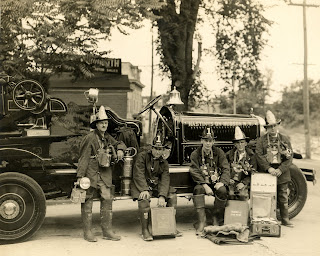
You can see the companion photographs below, one showing two masked firemen working on a piece of machinery, and the other showing the rescue squad with their truck and equipment. The firemen in the lower photograph are, from left to right, Frederick Koster, James Doran, William Wright, Dennis Sweeny, and George Dale. The photographs were donated to the society in 1990 by Denis Sweeny’s family.

The photographs are stamped on the back with Lewis Hine’s name, and we can take a guess that they were taken in the mid-1930s. The rescue squad was formed in 1933. The Historical Society owns a small but important collection of Lewis Hine photographs, all taken in the village for projects ranging from a local business directory to the high school yearbook. (For more on this collection, see the online article by Frederic Perrier.)

But who are the boys in the photograph? Where were these photographs taken and why? For a magazine or newspaper article on some daring rescue the firemen had performed? One theory is that they were taken during a training exercise. But then, why document a training exercise? And what is the flaky stuff on the central boy’s face? We’d love to know!

DiggIt!Add to del.icio.usAdd to Technorati Faves